You’re in the Air Force and want to get into IT or cyber. Retraining can get you there. I did it in 2020 and went from optometry tech to SOC (security operations center) analyst to vulnerability management lead. Today I work in cloud security. Here’s how it worked, the one move that took most of the stress out of it, and what to check this week if you want to do the same.
My path at a glance
- 2019 · BuckleyHealth gets worseThe $15-an-hour math. I apply to retrain.
- Late 2019 – Jan 2020ASVAB retake, then Security+Both passed before tech school.
- Jan 2020 · KeeslerNetworking tech schoolThen COVID hits.
- 2020 · BuckleyExtra training: SOC analystThe Air Force goes all in on cyber.
- Late 2021 · WhitemanVulnerability management leadHome to Missouri. Diagnosis soon after.
- 2023Medically retiredLeave with cyber experience and certs.
- TodayCloud securityFedRAMP & AWS.
Why I needed a new career field
In 2019 I was an optometry tech at Buckley Air Force Base in Colorado (now Buckley Space Force Base). Small clinic, an optometrist who became a real mentor, and coworkers I loved working with. The people were never the problem. The job just wasn’t for me.
My body was also giving out. Back pain I’d had since my training days in San Antonio got worse, then came hip pain, neck pain, and sciatic nerve flare-ups that lasted four to six months. Some days I used a cane. Some days I couldn’t get dressed on my own. Years earlier a blood test had found HLA-B27, a gene linked to a disease called ankylosing spondylitis, but nothing had confirmed it yet.
So my wife and I asked the hard question: what happens if the Air Force medically separates me? I looked up what an optometry tech makes as a civilian. The average I found was about $15 an hour. It’s good, honest work, and plenty of techs build a life around it. But with two kids and plans for a third, the math didn’t work for us.
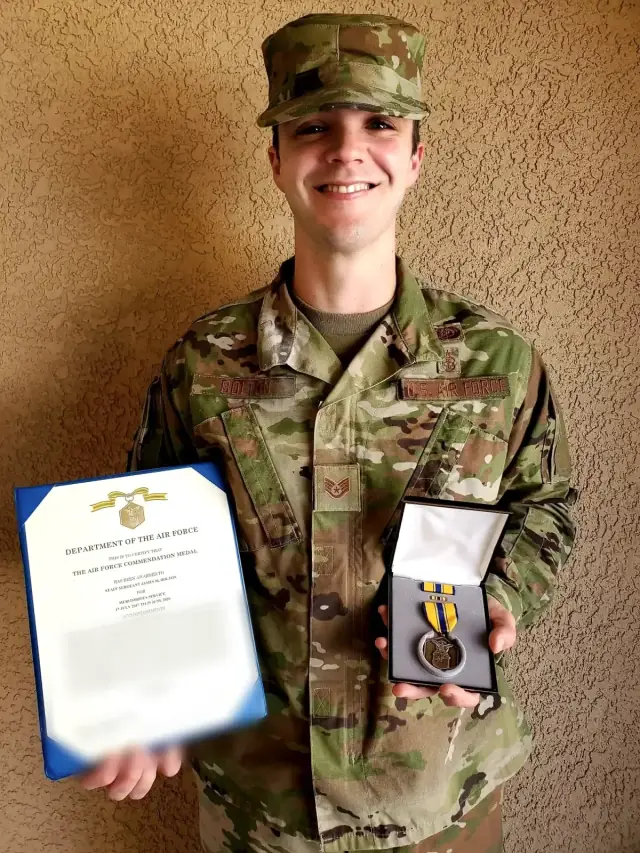 Getting my Commendation Medal as an optometry tech.
Why IT
One option was to go to optometry school. But my degree was in sports management, not science or medicine, so I’m not sure I’d even have been accepted. And if I had, it meant years more school for a field I wasn’t in love with.
So I asked around. I talked to friends and family who worked in IT and cyber. And one of my coworkers, a former programmer, kept telling me: “Go IT. It’s great in the military.”
My first goal wasn’t passion. It was taking care of my family. But the passion came with me anyway. In the clinic, I ran vision tests and helped people get the right lenses, so they could see clearly and live better. In cyber, I protect their data, their money, and their identity. Different tools. Same mission: take care of people.
Step 1: Check your timing and your ASVAB scores
I got lucky on timing. I was in my retraining window, and my career field was releasing a set number of people to retrain. Not everyone gets both. I listed every IT job I could.
Then I hit a snag. My ASVAB (the military’s aptitude test) from 2011 had an electronics score below what the IT career fields required. So I bought an ASVAB study book, spent two to three weeks going through it cover to cover, took every practice test, and retook the exam. I scored well above the minimum. Timing you can’t control. Your scores you can.
A month or two after applying, I was approved for Cyber Transport, the Air Force’s networking career field. (It’s since been folded into the newer 1D7 cyber career field, so check the current name if you’re looking it up.)
Step 2: Pass Security+ before tech school
This is the one move I’d tell every airman to make. Once I was approved, I learned I had to pass CompTIA Security+, an entry-level security certification, by the end of training. Fail it twice and you go back to your old career field.
I told myself that wasn’t happening to me. I had about two months before I left, so I bought a study book and Jason Dion’s Security+ course on Udemy. All out of pocket, on an airman’s pay, with no reimbursement. The exam voucher alone was about $340 back then. I read the book front to back, watched the whole course, and did practice test after practice test. I took the exam about two weeks before I left and passed on the first try.
Showing up with the cert already done meant I didn’t have to wait around to test. At tech school, I only had to focus on passing the course, and I left two weeks early.
If your new career field needs Security+ and you have the time, get it before tech school. Requirements change, so confirm the current rule for your career field.
Step 3: Get through tech school
I started at Keesler AFB in Mississippi in January 2020. It felt like a CCNA course (Cisco’s entry-level networking cert) on steroids: configuring switches and routers, converting binary and hex, multiplexing, network fundamentals from the ground up.
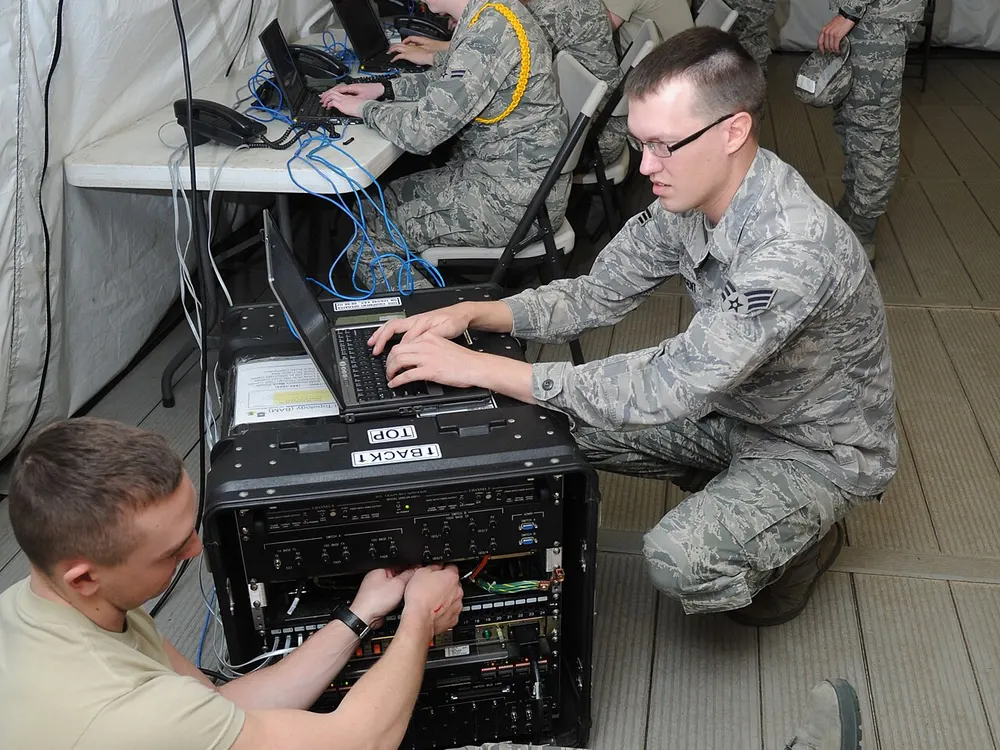 Not me, but this is what communications training at Keesler looks like: client systems students wiring up a network in 2015. (U.S. Air Force photo by Kemberly Groue)
A couple of months in, COVID hit. The base locked down, my wife and kids were back in Colorado without me, and we needed a special pass just to get to class. It was a rough stretch, but because Security+ was already done, the course was the only thing I had to get through. Clear everything you can off your plate before you go. You can’t predict what tech school will throw at you.
Step 4: Be ready for plans to change
My orders sent me back to Buckley. After two weeks of quarantine, I walked into my new squadron, and the first thing leadership told me was: “You’re not doing networking here. We’re going cyber.”
The Air Force was pushing hard to build up cyber people. I went through two to three more months of training and testing, then worked the floor as a SOC analyst (the team that watches for attacks).
None of that made tech school a waste. Networking is a must-have in cyber: you can’t defend a network you don’t understand. What I learned at Keesler has paid off ever since.
In late 2021, my squadron became a Space Force unit, so those of us who were still Air Force had to PCS (permanent change of station: the military’s word for moving to a new base). I was fortunate enough to get orders back close to home: Whiteman AFB in Missouri. There I became the base’s vulnerability management lead.
What carried over from optometry
More than I expected:
- Attention to detail. In the clinic, the tech is the first line of defense: you notice something off, flag it, and the optometrist verifies. That same instinct shows up all over cyber. In a SOC, for example, you watch network traffic, spot what’s off, and escalate it.
- People skills. I talked to patients all day. Now I talk to leadership and customers, and I can break technical details into something anyone can follow. That’s rarer in IT and cyber than you’d think, and it’s helped me more than any cert.
Why it mattered
The thing my wife and I worried about in 2019 happened. Not long after I got to Whiteman, I was diagnosed with ankylosing spondylitis, and in 2023 I was medically retired. That ended my time in uniform, but not my career. Because I’d retrained, I left with cyber experience and certs, and I’ve stayed in cyber ever since. Today I work in cloud security, focused on FedRAMP, the federal government’s security program for cloud services. That includes FedRAMP 20x, its newer, faster path to approval.
What to do this week
- Check your retraining window. There’s a minimum time in service before you can apply, and a point where the window closes. Ask your supervisor and check your personnel records.
- Check if your career field is releasing people. If it’s undermanned, retraining can get denied because they can’t lose you. Your career field manager can help.
- Check your ASVAB line scores. Compare them against the jobs you want. If one is short, a study book and a retake can fix it in a few weeks.
- Research the jobs. Find someone in the career field and ask what they actually do all day. Make sure you’re interested before you apply.
- Start on Security+ if cyber is the goal. Pick a book and a practice-test course, then book the exam date so you have a deadline. Learn networking basics too; you’ll use them in any cyber job.
Did you retrain, or are you thinking about it? I’d love to hear how your process went, or help you think it through. Send me a message.